
Search Questions
Search


Q: .
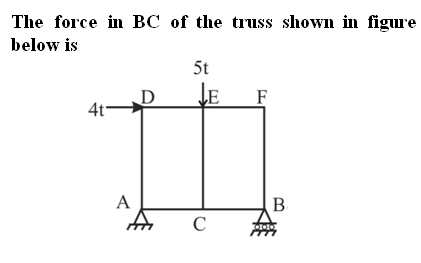
- A. 4t tension
- B. 4t compression
- C. 5t tension
- D. None of these
Correct Answer:
Option D - If three members form a truss joint for which two of the members are collinear and there is no external load or reaction at that joint, then the third non-collinear member is a zero force member.
• For the given truss consider joint B, member BC & BF are connected to joint B and the reaction at point B is acting vertically upwards in the direction of member BF. Hence, another member BC has to be a zero force member.
D. If three members form a truss joint for which two of the members are collinear and there is no external load or reaction at that joint, then the third non-collinear member is a zero force member.
• For the given truss consider joint B, member BC & BF are connected to joint B and the reaction at point B is acting vertically upwards in the direction of member BF. Hence, another member BC has to be a zero force member.
Explanations:
If three members form a truss joint for which two of the members are collinear and there is no external load or reaction at that joint, then the third non-collinear member is a zero force member. • For the given truss consider joint B, member BC & BF are connected to joint B and the reaction at point B is acting vertically upwards in the direction of member BF. Hence, another member BC has to be a zero force member.Address
12, Church Ln, The Adelphi, Allen Ganj, Prayagraj, Uttar Pradesh 211002
+91 9554973128
info.yctbooks@gmail.com
Download Our App