
Search Questions
Search


Q: .
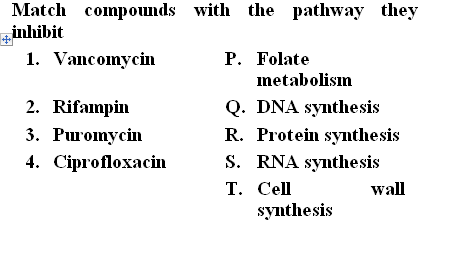
- A. 1-T, 2-S, 3-R, 4-Q
- B. 1-R, 2-S, 3-T, 4-P
- C. 1-Q, 2-R, 3-T, 4-Q
- D. 1-T, 2-Q, 3-P, 4-S
Correct Answer:
Option A - • Vancomycin inhibits cell-wall synthesis in gram-positive bacteria.
• Rifampin inhibits RNA synthesis.
• Puromycin is a naturally occurring aminonucleoside antibiotic that inhibits protein synthesis by ribosome catalyzed incorporation into the C-terminus of elongating nascent chains.
• Ciprofloxacin inhibits DNA gyrase, but its bactericidal effects are not completely reversible by inhibitors of protein or RNA synthesis.
• Compounds with the pathway they inhibit–
Vancomycin – Cell
Rifampin – RNA synthesis
Puromycin – Protein synthesis
Ciprofloxacin – DNA synthesis
A. • Vancomycin inhibits cell-wall synthesis in gram-positive bacteria.
• Rifampin inhibits RNA synthesis.
• Puromycin is a naturally occurring aminonucleoside antibiotic that inhibits protein synthesis by ribosome catalyzed incorporation into the C-terminus of elongating nascent chains.
• Ciprofloxacin inhibits DNA gyrase, but its bactericidal effects are not completely reversible by inhibitors of protein or RNA synthesis.
• Compounds with the pathway they inhibit–
Vancomycin – Cell
Rifampin – RNA synthesis
Puromycin – Protein synthesis
Ciprofloxacin – DNA synthesis
Explanations:
• Vancomycin inhibits cell-wall synthesis in gram-positive bacteria. • Rifampin inhibits RNA synthesis. • Puromycin is a naturally occurring aminonucleoside antibiotic that inhibits protein synthesis by ribosome catalyzed incorporation into the C-terminus of elongating nascent chains. • Ciprofloxacin inhibits DNA gyrase, but its bactericidal effects are not completely reversible by inhibitors of protein or RNA synthesis. • Compounds with the pathway they inhibit– Vancomycin – Cell Rifampin – RNA synthesis Puromycin – Protein synthesis Ciprofloxacin – DNA synthesisAddress
12, Church Ln, The Adelphi, Allen Ganj, Prayagraj, Uttar Pradesh 211002
+91 9554973128
info.yctbooks@gmail.com
Download Our App